An LLM platform lets epilepsy patients text with their EEG device
Retraining the seizure detector on patient feedback alone cut false alarms by 77–81% in a pseudoprospective simulation
From breakthrough paper to licensing deal. Weekly briefs on the research reshaping drug discovery, and the deals and conferences where it changes hands.
Opens your email app with a pre-filled request; we add you by hand. Free, unsubscribe any time.
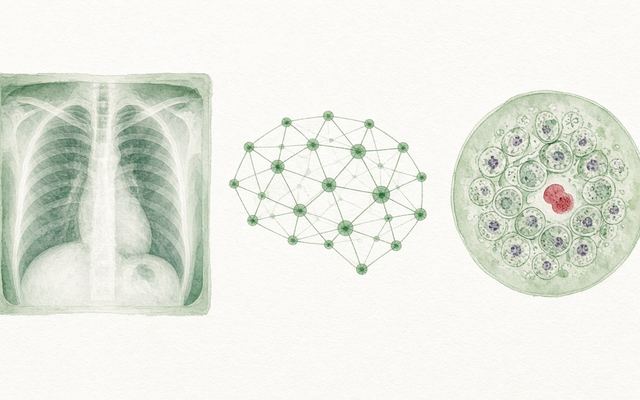
In 13 inpatients at Penn's epilepsy monitoring unit, a chatbot linked to live scalp or intracranial EEG answered questions, sent seizure and sleep alerts and collected feedback; in a pseudoprospective simulation, retraining the detector on that feedback alone cut false alarms by 77–81% without losing sensitivity. Live sessions used only the baseline detector.
Retraining the seizure detector on patient feedback alone cut false alarms by 77–81% in a pseudoprospective simulation
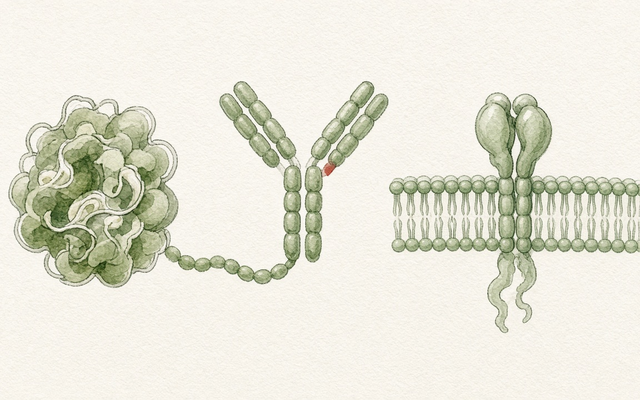
Fusing IL-18BP to a humanized anti-IL-4Rα antibody suppressed type 1, 2 and 3 inflammation more broadly than dupilumab or IL-18BP-Fc
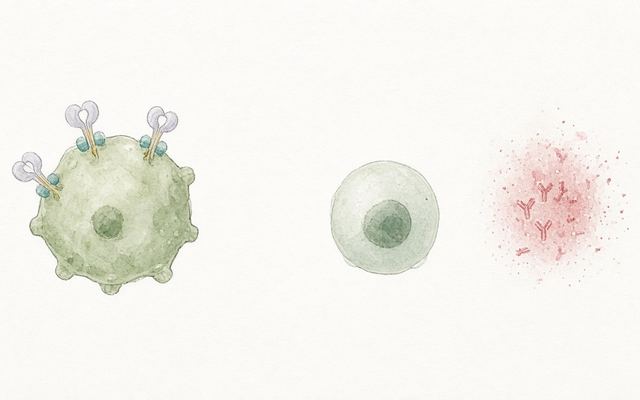
A CD19 CAR plus constitutive FOXP3 turns CD4 T cells into regulatory cells that both deplete B cells and suppress autoimmunity
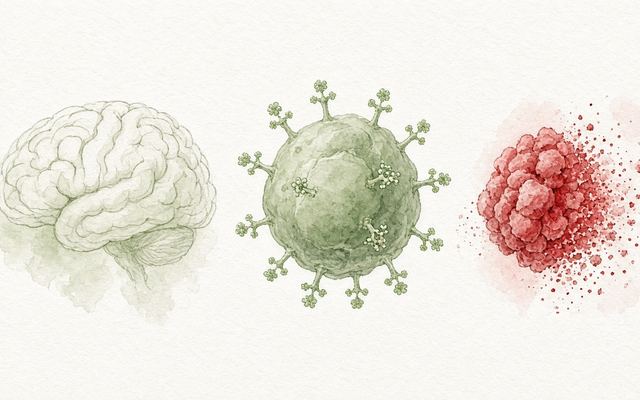
The brain starves innate lymphoid cells of IL-15; restoring it locally lets them control metastasis without T cells
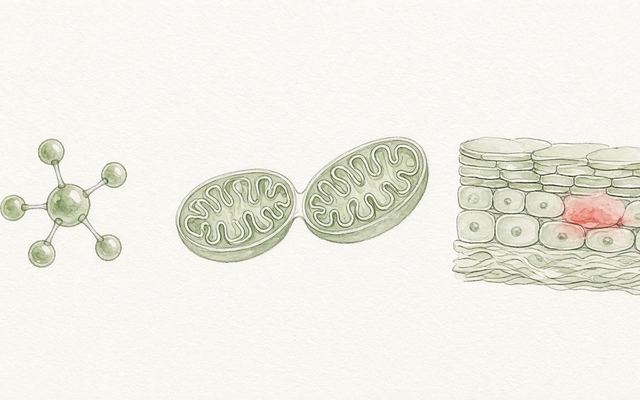
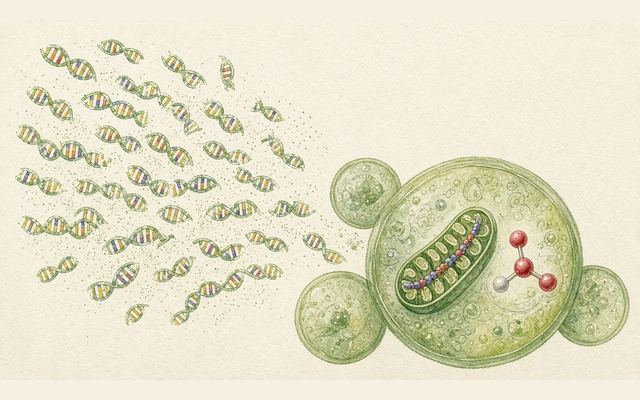
A plant-derived small molecule tunes mitochondrial dynamics to switch off the NFKBIZ program that drives psoriatic inflammation
One open-weight model family, medically tuned from Gemma 3, spanning medical images and text
Barcoded constructs delivered at high multiplicity turn each cell into its own pathway experiment
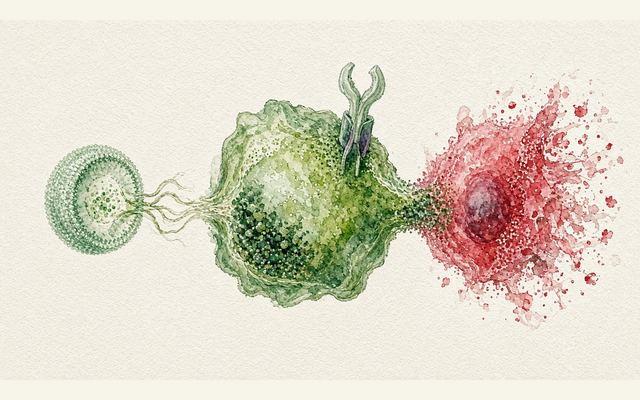
Green CAR-T cells attacking a red myeloma cell at right
The authors built NK cell-targeted lipid nanoparticles using engineered biparatopic NK cell ligands for receptor-specific uptake and mRNA delivery, reaching up to about 80% NK cell transfection in mice with minimal off-target effects. Systemic delivery of chimeric antigen receptor mRNA generated CAR-NK cells in vivo: CD19-targeted CAR-NKs completely depleted circulating B cells in healthy mice, and CD3-targeted CAR-NKs eliminated nearly all autoreactive T cells in an autoimmune hepatitis model. In solid tumors, nanoparticles targeting the inhibitory checkpoint NKG2A enhanced antitumor efficacy by relieving Qa-1b-mediated immunosuppression, and optimized particles enabled regression of two humanized hematologic malignancy models.
基于摘要 / Based on abstract · Generated:D2C7-ATC is a recombinant antibody-toxin conjugate targeting wild-type EGFR and EGFRvIII. In a single-arm, single-site, open-label phase 1 trial (NCT02303678), 81 patients with biopsy-confirmed recurrent malignant glioma received one infusion by convection-enhanced delivery. Median overall survival was 7.9 months among the 72 patients with IDH wild-type recurrent glioblastoma; the recommended phase 2 dose was 6,920 ng/ml, and the maximum tolerated dose was exceeded at 35,032 ng/ml where four patients had dose-limiting toxicities. Treatment-related adverse events were mainly grade 1-2 (67%); eight patients died on trial, all unrelated to D2C7-ATC. In univariate analyses, patients with IDH wild-type recurrent glioblastoma whose pre-treatment tumour D2C7 antibody reactivity score was below 1.5+ had a median overall survival of 17.38 months.
基于摘要 / Based on abstract · Generated:This preprint perspective asks why increasingly sophisticated models of TCR antigen specificity, from small neural networks to deep generative models and large protein language models, largely fail in independent benchmarks to generalise to TCRs or pMHCs absent from development data. Analysing the largest public TCR:pMHC repositories, the authors report significant biases towards a few antigens and MHC molecules, sparse sampling of TCR sequence space per pMHC, and inconsistent or inaccurate data collation. They argue evaluations must measure antigen-specific discrimination rather than confounders, and that metrics should match the downstream application.
Preprint perspective · 基于摘要 / Based on abstract · Generated:Bar length = total deal value; dark segment = combined upfront payments. Data: DIA Global Forum, March 2026. Most of the headline value is milestones that are paid only if development succeeds. Every deal we track, with sources →
Working on an asset or a landscape report? See Services →
New science briefs and cross-border licensing & M&A deals, each with a link to the original source. Free; unsubscribe any time.
Sources cited in our briefs. Science: Nature ×13, Nature Portfolio ×18, Cell Press ×2, bioRxiv ×6, Taylor & Francis ×1, JCI ×1, Company of Biologists ×1, NEJM ×1. Deals: BioPharma Dive ×4, AllSci ×3, Fierce Biotech ×3, BioSpace ×2, BioPharm International ×1, BioXconomy ×1, DIA Global Forum ×1, HKEXnews ×7, SEC EDGAR ×2, PR Newswire ×6, GlobeNewswire ×2, Business Wire ×1, Company press releases ×12. Counts = briefs or citations per source; every item links to its original.