CD19 CAR-engineered regulatory T cells drive durable tolerance in experimental lupus
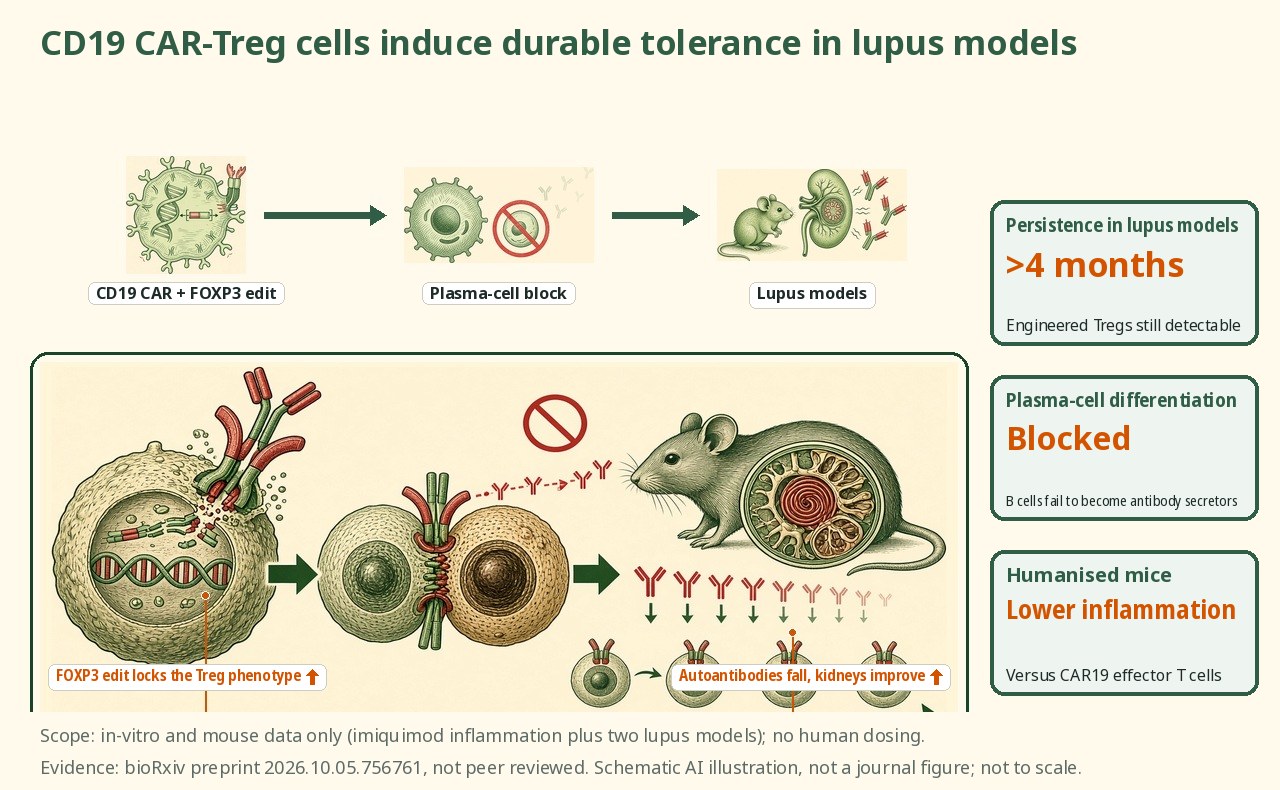
A preprint combines a CD19 CAR with homology-directed knock-in of constitutive FOXP3 to make CAR19-engineered regulatory T cells (CAR19 EngTreg); the cells carry canonical Treg markers, produce minimal inflammatory cytokines, block human plasma-cell differentiation, and in two mouse lupus models persist for more than four months with sustained autoantibody reduction and improved renal function and histopathology.
Preprint. This study has not yet been peer reviewed; findings may change.
CD19 CAR delivery was combined with homology-directed repair at the FOXP3 locus to drive constitutive, stable FOXP3 expression in CD4 T cells, producing CAR19 EngTreg that expressed canonical Treg markers, produced minimal inflammatory cytokines, and blocked human B-cell differentiation into antibody-secreting plasma cells. In humanized mice, CAR19 EngTreg reduced B-cell numbers with lower inflammatory cytokine production than CD19 CAR effector T cells (CAR Teff) and reduced tissue inflammation. In a short-term imiquimod-induced inflammatory model, murine CAR19 EngTreg reduced skin pathology, spleen size and inflammatory cytokines. In two distinct mouse models of lupus, CAR19 EngTreg persisted for more than four months, reduced autoimmune T- and B-effector populations, produced a sustained reduction in multiple autoantibodies, and improved renal function and histopathology. Exact cohort sizes, the specific lupus models and individual autoantibody values are not stated in the available preprint abstract.
Background and open questions
Systemic lupus erythematosus (SLE) is an autoantibody-driven autoimmune disease in which loss of self-tolerance leads to immune-complex deposition and organ damage, with the kidney a frequent and serious target, and lupus nephritis a major driver of morbidity and mortality. Over the past few years, CD19 CAR T-cell therapy has produced striking responses in refractory lupus by deeply depleting B cells and appearing to "reset" the autoimmune compartment. Yet how durable that benefit is, and whether transient B-cell depletion alone is enough to re-establish lasting tolerance, remain open questions.
The authors note that loss of tolerance in SLE is driven by extrafollicular and germinal-center interactions between dendritic cells and self-reactive T and B cells. A therapy that only removes B cells leaves the T-cell side of that circuit largely untouched, and conventional CAR effector T cells can drive inflammatory toxicities such as cytokine release syndrome. The question this study targets is whether a single engineered cell product can combine the targeting power of a CD19 CAR with the suppressive, tolerance-promoting biology of a regulatory T cell, so that both autoreactive B cells and the T cells that help them are controlled without a strong inflammatory signature.
Study design
To build such a cell, the team combined CD19 CAR delivery with homology-directed repair (HDR) at the FOXP3 locus. FOXP3 is the master transcription factor of regulatory T cells; by knocking in a construct that drives constitutive, stable FOXP3 expression in CD4 T cells, the authors aimed to lock an otherwise conventional T cell into a regulatory program while simultaneously arming it with a CD19-targeting CAR. The resulting cells are termed CAR19 engineered regulatory T cells (CAR19 EngTreg).
The study then moved through a layered set of models. First, in vitro human assays characterised the engineered cells' phenotype, cytokine output and functional effect on B cells. Second, humanized mice tested whether the cells could reduce human B-cell numbers in vivo and how their inflammatory profile compared with CD19 CAR effector T cells. Third, a short-term imiquimod-induced inflammatory model in mice, using a murine version of the construct, tested whether the regulatory cells could dampen an acute inflammatory flare. Finally, two distinct mouse models of lupus tested the central hypothesis: that the cells could persist, control both B- and T-cell autoimmunity, and protect target organs over months rather than weeks. Exact cohort sizes, cell doses and the identities of the two lupus models are described in the full preprint but are not captured in the available abstract.
Key results
A stable regulatory phenotype that still depletes B cells
The engineered cells expressed canonical regulatory T-cell markers, confirming that constitutive FOXP3 knock-in produced a bona fide Treg-like phenotype rather than a conventional effector cell. Critically, they produced minimal inflammatory cytokines, the property the authors sought in order to avoid the inflammatory toxicities associated with CAR effector T cells. Despite this quiet cytokine profile, the cells retained the functional ability conferred by the CD19 CAR: in vitro they blocked human B-cell differentiation into antibody-secreting plasma cells, directly addressing the cellular source of pathogenic autoantibodies. In SLE, it is the differentiation of autoreactive B cells into long-lived antibody-secreting cells that sustains the autoantibody burden, so blocking that step in a controlled, non-inflammatory way is a mechanistically attractive goal.
Lower inflammation than CAR effector T cells in humanized mice
In humanized mice, transfer of CAR19 EngTreg reduced B-cell numbers. Compared with CD19 CAR effector T cells, the engineered Tregs achieved this with lower inflammatory cytokine production and reduced tissue inflammation. This head-to-head contrast is central to the therapeutic argument: it suggests the regulatory format can deliver CD19-directed B-cell control while carrying a gentler inflammatory signature than the effector-cell therapies now used in the clinic.
Reduced acute inflammation in the imiquimod model
In a short-term imiquimod-induced inflammatory model, the murine CAR19 EngTreg reduced skin pathology, decreased spleen size and lowered inflammatory cytokines. This acute model provided an in vivo demonstration that the cells' suppressive function translates into measurable reductions in inflammation and immune activation, not only in vitro B-cell effects. The reduction in spleen size, a crude but informative index of lymphoid expansion, is consistent with broad dampening of the activated immune compartment.
Durable tolerance in two lupus models
The most important findings came from two distinct mouse models of lupus. In both, CAR19 EngTreg persisted for more than four months, indicating durable engraftment rather than a transient effect. Over that period the cells reduced autoimmune T- and B-effector populations, produced a sustained reduction in multiple autoantibodies, and improved renal function and histopathology. Taken together, these readouts support the idea that a single engineered cell can simultaneously control the B-cell and T-cell arms of lupus autoimmunity and protect the kidney, the organ whose involvement drives much of lupus morbidity. The abstract reports these as directional improvements; it does not provide the numeric effect sizes, which are in the full text.
Mechanistic interpretation
Demonstrated in the paper: Combining a CD19 CAR with HDR-driven constitutive FOXP3 expression generates CD4 T cells that behave as regulatory cells (canonical markers, low inflammatory cytokines) while retaining CD19-directed activity against B cells, including suppression of plasma-cell differentiation. In vivo, the cells reduce B cells with less inflammation than CAR effector T cells, blunt acute inflammation, and in lupus models persist for months while lowering autoreactive T and B effectors, reducing autoantibodies and protecting the kidney.
Author hypotheses: The authors propose that, because EngTreg can suppress multiple autoimmune effector cell types rather than only deplete B cells, they may promote long-term tolerance without the high levels of inflammatory mediators seen with conventional CAR effector cells. They position CAR19 EngTreg as a durable therapeutic avenue for B-cell-mediated autoimmune disorders capable of regulating both autoreactive B and T cells over the long term.
Limitations and uncertainties
- This is a bioRxiv preprint and has not been peer reviewed; conclusions and any numeric values may change on revision.
- The data are preclinical, from in vitro human assays, humanized mice and mouse lupus models; there are no human efficacy or safety outcomes.
- Exact cohort sizes, cell doses, the specific lupus models used and the individual autoantibodies measured are not stated in the available abstract.
- Several authors are current or former employees of GentiBio and senior authors are inventors on related patents, which is a relevant financial interest; durability beyond four months, infection risk from combined B- and T-cell suppression, and manufacturing were not addressed in the abstract.
Clinical and industry implications
If the approach holds up in peer review and translates, CAR19 EngTreg would represent a conceptual step beyond current CD19 CAR T-cell therapy for lupus: instead of transiently depleting B cells and relying on an immune "reset," an engineered regulatory cell could provide ongoing suppression of both the B cells and the helper T cells that sustain autoimmunity, potentially with a lower inflammatory toxicity profile. The persistence beyond four months and the organ-level protection in lupus models are the features most relevant to the central clinical question of durable, drug-free remission. Several authors are affiliated with GentiBio, which is developing CAR-engineered regulatory T-cell therapies for B-cell-driven autoimmune disease, so the academic work sits alongside an industry translation effort. The immediate contribution, however, is preclinical proof of concept: human trials, head-to-head safety comparisons with existing lymphodepleting CAR regimens, and evidence that tolerance is maintained after the cells wane are all still required.
Authors and source
Travis Drow (Seattle Children's Research Institute) is first author. Co-authors include Matteo Doglio and Chiara Bonini (Experimental Hematology Unit, Division of Immunology, Transplantation and Infectious Diseases, IRCCS San Raffaele Scientific Institute, Milan, Italy); a large group of current or former GentiBio employees (Cambridge, Massachusetts), including Victoria DeVault-Nelson, Maegan Hoover, Jennifer Mellen, Payam Zarin, Alaina Burgess, Christopher L. Moore, Chandra Patel, Tiffany Chen, Alberto Del Rio-Espinola and Tom Wickham; and collaborators at the University of Washington. Corresponding authors are David J. Rawlings (Seattle Children's Research Institute; Departments of Pediatrics and Immunology, University of Washington) and Peter J. Cook (Seattle Children's Research Institute). Funding was declared from GentiBio and Seattle Children's. Several authors disclose employment or consulting relationships with GentiBio and related companies, and senior authors are inventors on a patent describing methods for generating antigen-specific engineered regulatory T cells.
Preprint (not peer reviewed): https://doi.org/10.64898/2026.10.05.756761 ; https://www.biorxiv.org/content/10.64898/2026.10.05.756761v1 ; licence CC BY-NC 4.0. Posted 11 October 2026.
Numbers are as reported by the authors. Corrections: contact@
Related science
TEM1657 suppresses NFKBIZ and eases psoriasis-like inflammation in mice
A plant-derived small molecule tunes mitochondrial dynamics to switch off the NFKBIZ program that drives psoriatic inflammation
Anti-CD19 CAR-T in refractory MG: 3 patients in treatment-free remission for at least 19 months
The neuromuscular junction at left, CAR-T cells clearing red B cells at right
GPR15 guides regulatory CD8 T cells to the colon, with a 42% reduction in sporadic UC
Green regulatory T cells homing to the intestinal epithelium, with red dots marking homing receptors
One email, with links to every paper. Reports and custom landscapes: contact@inlightbio.com.
Opens your email app with a pre-filled request; we add you by hand. Free, unsubscribe any time.