FJ-0125, a bispecific that blocks both IL-18 and IL-4Rα, outperforms dupilumab in a mouse model of atopic dermatitis
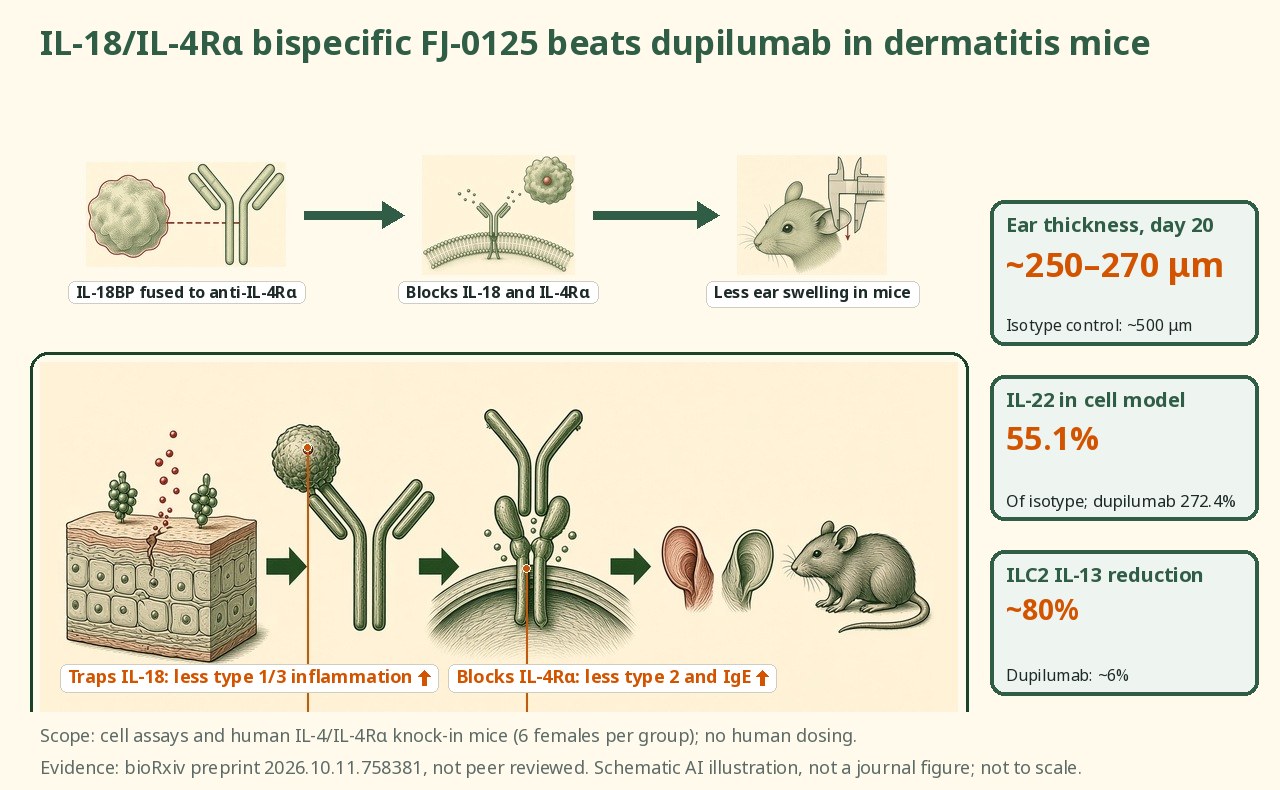
A preprint fuses the natural IL-18 decoy IL-18BP to a new humanized anti-IL-4Rα antibody. In cell assays and in a mouse model of S. aureus-associated dermatitis, it suppressed type 1, type 2 and type 3 inflammation more broadly than dupilumab or IL-18BP-Fc alone, and it prevented the rise in IL-22 seen with IL-4Rα blockade alone.
Preprint. This study has not yet been peer reviewed; findings may change.
Background and open questions
Atopic dermatitis (AD) is mainly driven by type 2 immunity (IL-4 and IL-13). Type 1 (IFN-γ) and type 3 (IL-17/IL-22) inflammation also contribute, and they vary with disease stage, body site, age and ethnicity. Dupilumab, which blocks the shared IL-4 receptor α chain, confirmed type 2 signalling as a target. However, many patients respond only partly, lose response over time or develop paradoxical inflammation, and residual disease is often linked to non-type 2 inflammation.
The authors point to IL-18, an alarmin that skin cells release when the barrier is damaged or exposed to S. aureus, as a possible upstream amplifier. Genetic variants near IL18R1 are linked to AD risk, and IL-18 levels track disease severity. IL-4 also suppresses IL-18 receptor expression on T cells, and blocking IL-4Rα has been associated with more IL-18 and with persistent IL-22 in patients. The question was whether blocking IL-18 and IL-4Rα together, in one molecule, would control all three types of inflammation better than blocking either alone.
Study design
The team made a new humanized anti-IL-4Rα antibody (hIL4R-0125; affinity 5.0 × 10⁻¹² M) and fused human IL-18BP, the body's natural IL-18 decoy, to it. They used a knob-into-hole IgG4 backbone with mutations that remove Fc effector function. They compared FJ-0125 with dupilumab, IL-18BP-Fc and an isotype control in five sets of experiments:
- Binding assays.
- IL-4/IL-13 reporter cells.
- IL-18-stimulated human and mouse immune cells.
- Human ILC2s and primed Th2 cells.
- A co-culture in which skin cells exposed to S. aureus prime dendritic cells, which then activate naïve T cells.
In vivo, they induced dermatitis in mice that carry human IL-4 and human IL-4Rα by applying MC903 and S. aureus Mu50 to the ear. Each group had six mice. Treatment started on day 5, at roughly equimolar doses, and assessors were blinded to treatment.
Key results
Both targets engaged, potency similar to dupilumab
FJ-0125 bound human IL-18 at 1.5 × 10⁻¹⁰ M and IL-4Rα at 2.4 × 10⁻¹¹ M, and it could bind both at once. It blocked IL-4 and IL-13 signalling with IC50s of 0.33 and 0.15 nM, versus 0.27 and 0.10 nM for dupilumab. It neutralized IL-18 in human cells (IC50 0.27 nM) and mouse cells (0.30 nM), close to IL-18BP-Fc (0.26 nM). It did not block a decoy-resistant IL-18 variant, which confirms that the IL-18 activity comes from the IL-18BP arm.
Broader suppression in human cells
IL-18 and TSLP together drove a strong IL-13 response in ILC2s. FJ-0125 cut that response by about 80%, IL-18BP-Fc by about 68% and dupilumab by about 6%. In primed Th2 cells, IL-18 raised IL-5, IL-13, IFN-γ and IL-22. FJ-0125 brought all four back to near unstimulated levels, as did IL-18BP-Fc, whereas dupilumab modestly lowered only IL-5 and left IL-22 at or above control levels.
Dupilumab raised IL-22 in co-culture; FJ-0125 did not
In the skin cell–dendritic cell–T cell co-culture, FJ-0125 lowered TARC to 17.7%, IL-13 to 21.3%, IFN-γ to 30.8% and IL-22 to 55.1% of the control level. Dupilumab strongly lowered TARC (15.4%) and IL-13 (36.7%), left IFN-γ at 113.3% and raised IL-22 to 272.4%. IL-18BP-Fc lowered IFN-γ (43.3%) and IL-22 (47.6%) but only partly lowered TARC (76.9%) and IL-13 (71.3%).
Better control of skin inflammation in mice
In control-antibody mice, ear thickness rose from about 200 μm to about 500 μm by day 20. FJ-0125 held it at about 250–270 μm (P < 0.0001 versus control), which was significantly lower than with dupilumab or IL-18BP-Fc. In ear tissue, FJ-0125 lowered all six cytokines measured: IL-4, IL-13, IFN-γ, IL-22, IL-17 and IL-6. Dupilumab lowered only the type 2 cytokines, and its IL-22 trended higher without reaching significance. IL-18BP-Fc mainly lowered IFN-γ and IL-22. Serum IgE fell with FJ-0125 and dupilumab but not with IL-18BP-Fc.
Clinical and industry implications
Most approved and late-stage AD drugs act on one dominant pathway. This preprint gives a mechanistic reason to pair IL-18 and IL-4Rα blockade. The authors link this to clinical reports that IL-22 and type 3 inflammation can persist or emerge during dupilumab treatment. They describe it as, to their knowledge, the first molecule to combine these two activities. All of this evidence comes from cell assays and a single 20-day mouse model in a company-funded preprint; whether broader suppression translates into better outcomes for patients has not been tested.
Mechanistic interpretation
Demonstrated in the paper: FJ-0125 binds IL-18 and IL-4Rα at the same time, matches dupilumab on IL-4/IL-13 blockade and IL-18BP-Fc on IL-18 neutralization, and its IL-18 activity depends on the IL-18BP arm (no effect on decoy-resistant DR-18). In ILC2s, Th2 cells, a keratinocyte–dendritic cell–T cell co-culture and one knock-in mouse model, it suppressed type 1, 2 and 3 readouts together, and it prevented the IL-22 rise seen with dupilumab in co-culture (2.7-fold; a non-significant trend in mice).
Author hypotheses: The authors propose that IL-4Rα blockade lifts IL-4/STAT6 repression of IL-18Rα on T cells, raising IL-18 responsiveness and unmasking an IL-18-driven type 1/type 3 programme; adding IL-18 neutralization would counter this. They suggest FJ-0125 may suit patients incompletely controlled by IL-4Rα blockade. None of this has been tested in patients.
Limitations and uncertainties
- This is a preprint and has not been peer reviewed.
- All data are preclinical. Efficacy was shown in one 20-day mouse model with six female mice per group (males were not tested), and there are no human data; the authors call for additional models and longer-term studies.
- The authors note that the epitope of the anti-IL-4Rα arm and the molecule's pharmacokinetics, stability and immunogenicity are not yet known.
- Long-term IL-18 neutralization could weaken antimicrobial and antitumour immunity, which the authors say needs evaluation.
- Many in vitro effects are reported as approximate percentages. Tissue cytokine values are shown only in figures.
- The work was partly funded by Ferry Jam Biotechnology. Co-corresponding author You Leo Li and co-author Xianqiang Ping are Ferry Jam affiliates, and the preprint contains no separate competing-interests statement.
Authors and source
Zhang L, et al. Dual blockade of IL-18 and IL-4Rα by a bispecific antibody for improved treatment of atopic dermatitis. bioRxiv (preprint, not peer reviewed). Posted 17 October 2026. https://doi.org/10.64898/2026.10.11.758381 ; licence CC BY-NC-ND 4.0.
Numbers are as reported by the authors. Corrections: contact@
Related science

A pIgR bispecific raises cynomolgus BAL exposure 5.5-fold
A bispecific crossing airway epithelial cells and released at the airway surface
A 156-member bispecific screen selects a low-affinity SIRPα×CD38
A macrophage phagocytosing the tumour cell at right via a red bispecific
A trispecific IL-2R antibody reaches an EC50 of 0.015 nM with Treg bias
A green trispecific antibody binding a dark green regulatory T cell, with the rest quiescent
One email, with links to every paper. Reports and custom landscapes: contact@inlightbio.com.
Opens your email app with a pre-filled request; we add you by hand. Free, unsubscribe any time.