MedGemma: an open-weight medical vision-language model family built on Gemma 3
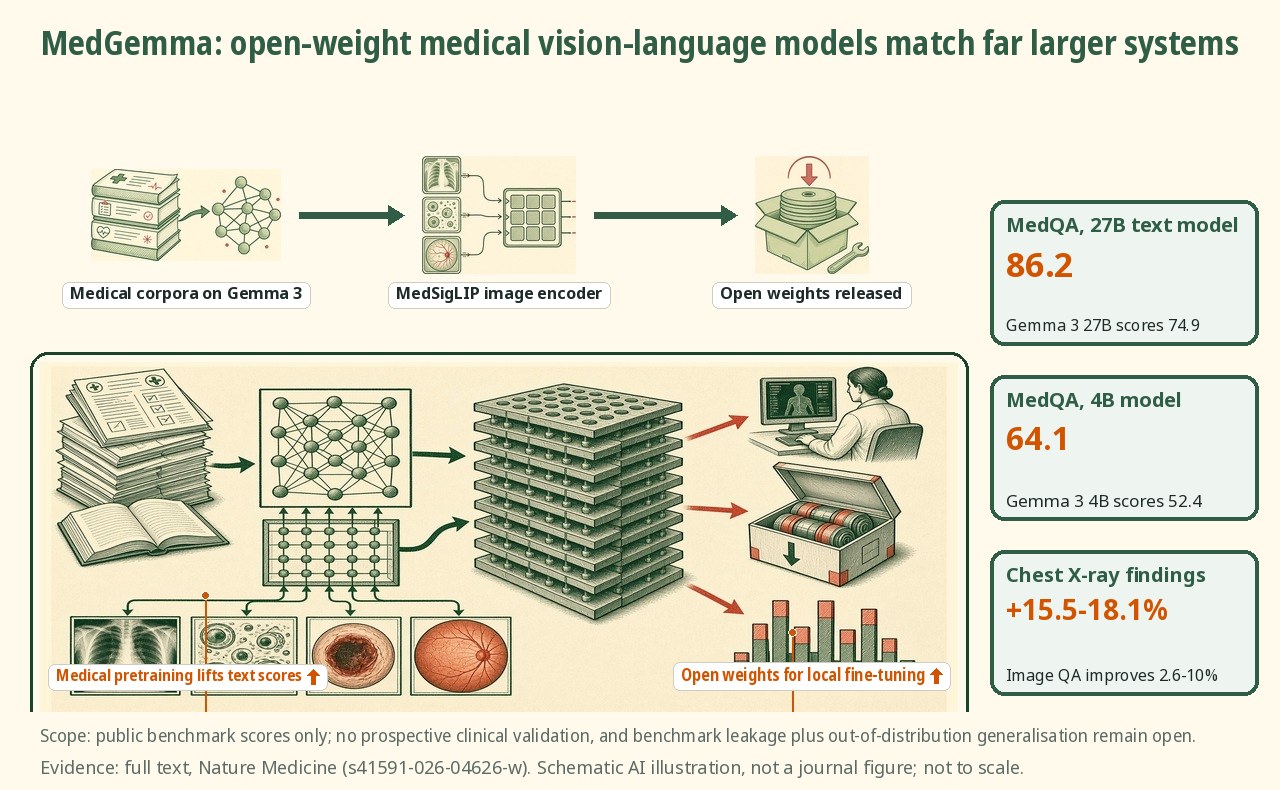
MedGemma is a collection of open-weight medical vision-language foundation models (4B multimodal, 27B multimodal, 27B text-only) built on Gemma 3, plus MedSigLIP, a ~400M-parameter medically tuned image encoder; MedGemma 27B Text scores 86.2 on MedQA versus 74.9 for Gemma 3 27B, and MedGemma 4B scores 64.1 versus 52.4, with out-of-distribution gains of 2.6-10% in medical image QA and 15.5-18.1% in chest X-ray finding classification.
Three variants (MedGemma 4B multimodal, MedGemma 27B multimodal, MedGemma 27B Text) were medically tuned on top of Gemma 3, sharing a 400M vision encoder (MedSigLIP) fine-tuned from SigLIP-400M on millions of medical image-text pairs. On MedQA, MedGemma 27B Text reached 86.2 (versus 74.9 for Gemma 3 27B) and MedGemma 4B reached 64.1 (versus 52.4 for Gemma 3 4B). Out-of-distribution improvements over the base models were 2.6-10% in medical image question answering, 15.5-18.1% in chest X-ray finding classification and 10.8% in agentic evaluations. Weights for MedGemma and MedSigLIP are released openly to support local evaluation and data-efficient fine-tuning. The authors flag benchmark leakage and out-of-distribution generalisation as limitations, and state public benchmark scores are not clinical validation.
Background and open questions
Modern healthcare generates unprecedented volumes and variety of data, and diagnosis, treatment and monitoring all depend on connecting evidence across imaging modalities, specialties and free text. General-purpose large multimodal models show broad ability but can lack the nuanced medical understanding needed to interpret and reason about medical data robustly. At the same time, the most capable frontier systems are large, closed and costly to run, which is a poor fit for settings that need data sovereignty, offline operation, frozen reproducible checkpoints or tight compute budgets.
In Nature Medicine, Sellergren, Kazemzadeh and colleagues at Google introduce MedGemma, a collection of medically tuned, open-weight vision-language foundation models built on Gemma 3, together with MedSigLIP, a medically tuned image encoder. The open question they target is whether a single, relatively small open base model can be specialized for medicine across many imaging domains and text tasks while retaining general-purpose ability, and whether it can serve as a data-efficient starting point for downstream fine-tuning.
Study design
MedGemma comprises three variants: two multimodal models, MedGemma 4B and MedGemma 27B, which accept text, images or both, and MedGemma 27B Text, optimized for text input. All are built on the Gemma 3 architecture and are compatible with existing Gemma infrastructure, with arbitrary image-text interleaving and a 128k context window. A shared 400-million-parameter vision encoder, MedSigLIP, was produced by fine-tuning the Gemma 3 SigLIP-400M encoder on millions of medical image-text pairs; to preserve general vision ability, the original SigLIP data were retained and medical data were mixed at roughly 2% weight. Images were processed at 896x896, while the separately released MedSigLIP runs at 448x448 using downsampled positional embeddings on the same weights.
Training proceeded in stages. The multimodal decoder was readapted to the enhanced encoder during pretraining with medical image-text data mixed at about 12% weight, continuing from Gemma 3 checkpoints. Post-training reused the Gemma 3 distillation and reinforcement-learning recipes, adding medical text during distillation and paired medical imaging-text during RL; all multimodal post-training was done by RL, which generalized better than supervised fine-tuning. MedGemma 27B Text used post-training alone. Evaluation spanned in-distribution and out-of-distribution benchmarks, with OOD defined as datasets or splits fully held out from encoder training, pretraining and post-training.
Key results
Medical text question answering
Across text-only biomedical question answering, MedGemma beat the same-size Gemma 3 baselines and was competitive with much larger models. MedGemma 27B Text scored 86.2 on MedQA versus 74.9 for Gemma 3 27B, and MedGemma 4B scored 64.1 versus 52.4 for Gemma 3 4B. At release, 86.2 was the best MedQA result for an open model other than the 671-billion-parameter DeepSeek-R1 (91.0), and well ahead of the next well-documented open model, OpenBioLLM 70B (78.2). Evaluation used MedQA, MedMCQA, PubMedQA, MMLU medical subsets, AfriMed-QA and the out-of-distribution MedXpertQA. On the MedHallu hard set, a third-party evaluation found MedGemma 4B scored 0.50 against 0.09 for Gemma 3 4B, suggesting better discrimination of plausible-but-wrong answers.
Medical image classification and visual question answering
On zero-shot medical image classification spanning chest X-ray, histopathology, dermatology and retina, MedGemma substantially exceeded the Gemma 3 baselines and outperformed much larger API-based models on several tasks. Out-of-distribution improvements over the base models were 2.6-10% in medical image question answering and 15.5-18.1% in chest X-ray finding classification. On medical VQA benchmarks SLAKE and VQA-RAD, MedGemma again beat base Gemma 3 and performed similarly to much larger API-based models. For anatomical structure localization on Chest ImaGenome, intersection-over-union was 0.16 for MedGemma 27B versus 0.08 for Gemma 3 27B, 0.03 for MedGemma 4B and 0.09 for Qwen3-VL 4B, indicating clear room for improvement.
Report generation, reasoning and agentic behaviour
For chest X-ray report generation on MIMIC-CXR (RadGraph F1), the pretrained MedGemma 4B matched or beat larger and task-specialized comparators, and RL fine-tuning reached a RadGraph F1 of 30.3 for findings plus impression, described as state of the art for that metric and dataset. Human experts rated 68% of generated reports from normal studies and 49% from abnormal studies as equal to or better than the originals, corresponding to 81% rated likely to yield the same or superior clinical decisions. In open-ended content questions, factually inaccurate responses fell by about 17% relative (18.5% for Gemma 3 4B versus 15.4% for MedGemma 4B). In the text-only AgentClinic benchmark, MedGemma 27B exceeded human physician performance on AgentClinic-MedQA and approached much larger models, with a 10.8% agentic improvement over the base model; the 4B models struggled to follow the agentic framework.
Fine-tuning efficiency and general capability
Fine-tuning experiments on three previously unseen datasets (SIIM-ACR pneumothorax, CRC100k histopathology, ISIC 2017 skin lesions) showed MedGemma 4B generally outperforming Gemma 3 4B, with the advantage most pronounced when only 10% of the data was used, supporting data-efficient adaptation. On SIIM-ACR, Gemma 3 collapsed to the majority class while MedGemma did not. On general, non-medical benchmarks (MMLU Pro, Global MMLU Lite, MMMU), MedGemma showed only minor decreases versus same-size Gemma 3, indicating specialization did not sacrifice broad ability. The authors note a roughly 500-fold compute-cost gap between MedGemma 4B and the most expensive comparator model.
Mechanistic interpretation
Demonstrated in the paper: Medical-domain adaptation of an open base model (Gemma 3) via a medically tuned shared vision encoder (MedSigLIP) plus staged pretraining and RL post-training yields consistent gains over same-size base models across text, image classification, VQA, report generation and agentic tasks, while largely preserving general-purpose performance. The gains are largest in vision tasks and in the data-limited fine-tuning regime, and the models deliver a strong size-to-performance ratio against far larger systems. MedSigLIP on its own supports data-efficient and zero-shot classification and retrieval comparable to or better than specialized encoders.
Author hypotheses: The authors attribute MedGemma's advantages to optimized incorporation of domain-specific data in both pretraining and post-training, and position the open release as enabling data and model sovereignty, offline use and extensive community adaptation. They suggest MedGemma is best when a frozen, local or cost-sensitive model is needed, while frontier models may remain preferable for optimal broad performance, and that the two can be combined in agentic settings. They caution these are baseline capabilities meant as a starting point, not finished clinical tools.
Limitations and uncertainties
- Benchmark performance is only a first step toward real-world validation; some benchmarks may be near saturation, and public benchmarks raise the possibility of test data leakage.
- Out-of-distribution generalisation remains a limitation, and public benchmark scores are explicitly not clinical validation.
- Specialized models can still outperform MedGemma on some tasks (for example, state-of-the-art histopathology encoders); multimodal coverage is two-dimensional, lacking 3D CT/MRI series and modalities such as genomics.
- Model errors and subtle distribution bias in training data remain risks; several training datasets are private and could not be shared, limiting full reproducibility. The work is from Google and funded by Alphabet, and nearly all authors are current or former Google employees.
Clinical and industry implications
MedGemma offers developers an open, relatively small foundation that can be run locally or offline, frozen for reproducibility, and fine-tuned efficiently for specific medical tasks, which is attractive where data sovereignty, cost or reliability constrain the use of closed frontier models. Plausible uses the authors highlight include medical image retrieval, linking radiology, histopathology, ophthalmology and dermatology with clinical text, extracting concepts for trial matching, pharmacovigilance and quality metrics, and assisting report generation within agentic frameworks. The immediate contribution is a unified, openly released starting point rather than a validated clinical product: real deployments still require use-case-specific fine-tuning plus thorough safety, performance and reliability validation.
Authors and source
Andrew Sellergren and Sahar Kazemzadeh (equal first authors) with a large Google team including Fereshteh Mahvar, Atilla Kiraly, Madeleine Traverse, Timo Kohlberger, Chufan Gao, Yun Liu, Shekoofeh Azizi, Dale Webster and others (Google, Mountain View, California); Charles Lau (Google via Advanced Clinical, Deerfield, Illinois); Catherine Kozlowski (Google via Buchanan Ingersoll and Rooney PC, Pittsburgh, Pennsylvania). Shravya Shetty, David F. Steiner, Rory Pilgrim, Daniel Golden and Lin Yang jointly supervised the work. Corresponding authors: Andrew Sellergren, David F. Steiner, Daniel Golden and Lin Yang. Funded by Alphabet; nearly all authors are current or former Google employees.
Full text (open access): https://doi.org/10.1038/s41591-026-04626-w ; https://www.nature.com/articles/s41591-026-04626-w ; licence CC BY 4.0. Models and code: https://goo.gle/medgemma and https://goo.gle/hai-def.
Numbers are as reported by the authors. Corrections: contact@
Related science
Rentosertib phase 2a: 21/54 aging-clock comparisons significant
A cell cluster with red-marked molecules, showing proteomic aging-related changes
511 AI antibodies benchmarked: only 9.8–13.8% beat the control in Challenge 2
Many antibodies pointing at a green antigen, with the best binder in red
NISE zero-shot design of drug-binding proteins: APEX affinity of 80 pM
A green designed protein enclosing a red small-molecule drug
One email, with links to every paper. Reports and custom landscapes: contact@inlightbio.com.
Opens your email app with a pre-filled request; we add you by hand. Free, unsubscribe any time.